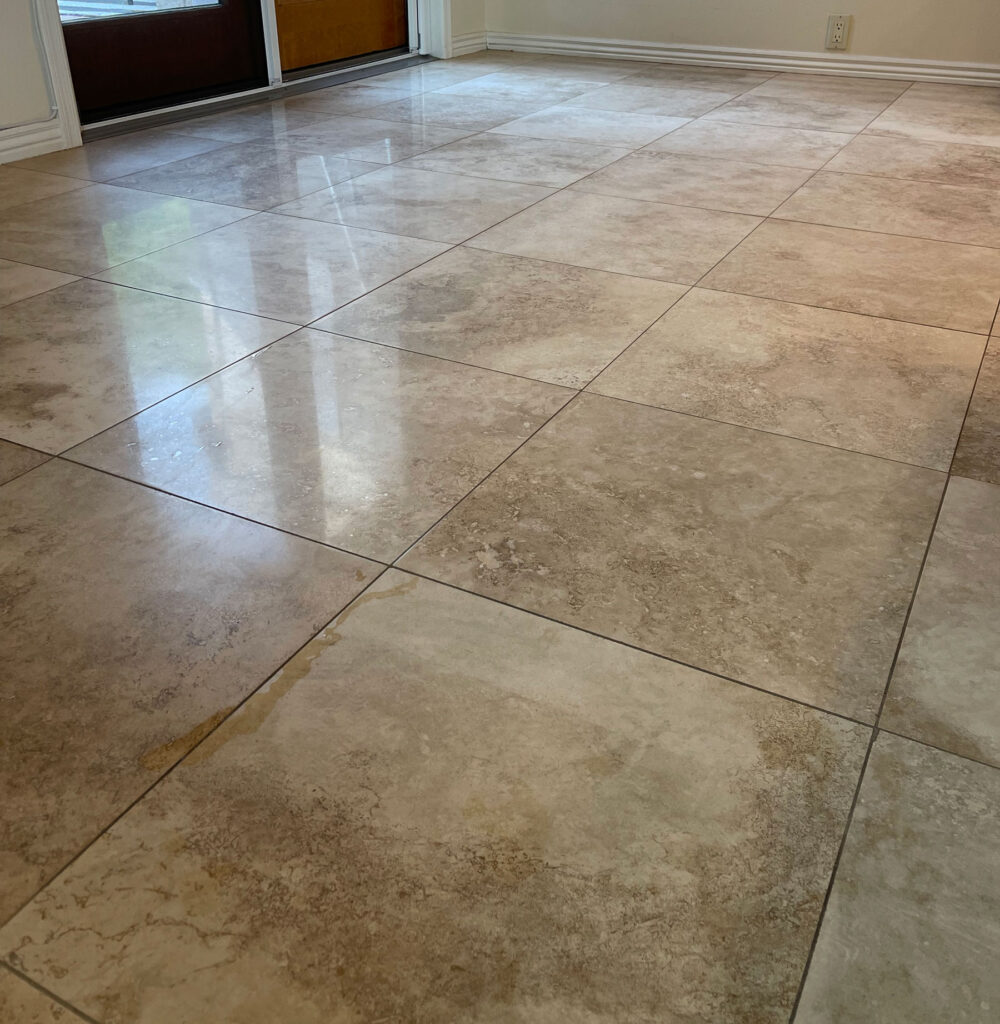
If your travertine floor was installed 15, 20 or even 30 years ago, you may be wondering whether it’s simply reached the end of its life.
It may be dull. The grout may be dark. High-traffic areas might look worn, while other sections still have some of their original finish. You may see scratches, small holes, stains or areas that never seem to look clean anymore.
Does that mean it’s time to tear everything out?
Not necessarily. A 20-year-old travertine floor can often be professionally restored without replacing it. In fact, age alone tells us very little about whether a natural stone floor can be saved.
Travertine Doesn’t Have a 20-Year Expiration Date
Travertine is natural stone. Unlike many manufactured flooring products, there isn’t a predetermined point when it simply wears out and must be replaced.
What matters is the condition of the stone and the installation beneath it.
If the tiles are structurally sound, many of the problems that make an older travertine floor look worn are actually surface problems that can be corrected.
What Happens to Travertine After 20 Years?
Two decades of everyday life can leave its mark on a floor.
Common problems we see with older travertine include:
- Dull or uneven finishes
- Fine scratches and traffic wear
- Etching
- Dirty or discolored grout
- Small holes and pits
- Missing or deteriorated filler
- Stains and spills absorbed into the stone
- Cleaning-product residue
- Uneven shine between high- and low-traffic areas
Here in Arizona, fine desert dust and grit can also contribute to wear. Tiny abrasive particles tracked across the floor under shoes and pets can gradually scratch and dull the surface.
None of these problems automatically means the floor needs to be replaced.
What Can Be Done to Restore an Older Travertine Floor?
The exact restoration process depends on the condition and desired finish of the floor.
It may include professional cleaning to remove accumulated dirt and residue, followed by honing to address scratches, etching and uneven wear.
If the floor originally had a more reflective finish, polishing can restore the desired level of shine. Small pits and areas where the original travertine filler has failed can often be repaired as well.
Grout can also be professionally cleaned and restored, which can make an enormous difference in the appearance of an older floor.
Once the restoration is complete, an appropriate sealer may be applied when needed to help protect the stone and grout.
Can Scratches and Dull Areas Really Be Removed?
Many can.
This is one of the advantages of natural stone. We’re not simply applying something on top of the floor to temporarily disguise wear.
Honing actually refinishes the stone’s surface.
Light and moderate scratches, etching, traffic patterns and dull areas can often be removed or substantially reduced, creating a much more consistent appearance across the floor.
Extremely deep scratches may not disappear completely if removing them would require taking too much material from the stone. A good restoration isn’t about chasing every tiny imperfection. It’s about restoring the overall appearance while preserving the floor.
What About Holes in Old Travertine?
Small holes aren’t unusual in travertine.
Travertine naturally contains voids, and many tiles are filled during manufacturing. After years of use, some of that filler can loosen, crack or fall out.
In many cases, these areas can be refilled and blended with the surrounding stone rather than replacing the entire tile.
For more information about specific types of damage, see Can Damaged Travertine Be Restored? What Can and Can’t Be Fixed.
What About 20-Year-Old Grout?
Old grout can sometimes make a travertine floor look worse than the stone itself.
Years of dirt, spills, cleaning products and normal use can leave grout significantly darker than it was originally. Because there are so many grout lines in a typical travertine installation, that discoloration affects the appearance of the entire room.
Professional grout cleaning or restoration can often make a dramatic visual difference without removing the floor.
When Should an Old Travertine Floor Be Replaced?
There are situations where restoration isn’t the answer.
Replacement or more extensive repair may be necessary when:
- Numerous tiles are badly cracked or broken
- Tiles are loose or separating from the substrate
- There is significant movement underneath the floor
- Structural problems are causing recurring cracks
- The installation itself is failing
- The homeowner simply no longer wants travertine
That’s an important distinction. A floor that looks worn isn’t necessarily a failing floor.
If the problem is primarily with the surface, restoration may be a much more sensible option than demolition and replacement.
Should You Restore Travertine Before Selling Your Home?
If an older travertine floor is otherwise in good condition, restoration can also be worth considering before putting a home on the market.
A dull floor with dirty grout can make an entire interior feel dated. Restoring the stone may reveal that the flooring itself wasn’t really the problem. It simply needed attention after years of use.
That can be particularly relevant in Scottsdale and other Arizona communities where travertine was installed extensively in homes built or remodeled during the 1990s and 2000s.
Don’t Replace a 20-Year-Old Travertine Floor Just Because It’s 20 Years Old
If your travertine has been in your home for decades, don’t assume its age means replacement is inevitable.
The Grout Nurse can evaluate the condition of the stone, grout and installation and determine whether professional cleaning, honing, polishing, filling, sealing or other restoration work can bring it back.
You can also read our Complete Guide to Natural Stone Restoration in Arizona to learn more about how natural stone restoration works.
Before you pay to tear out thousands of square feet of natural stone, find out what you’ve already got. Contact The Grout Nurse and let us take a look at your older travertine floor.