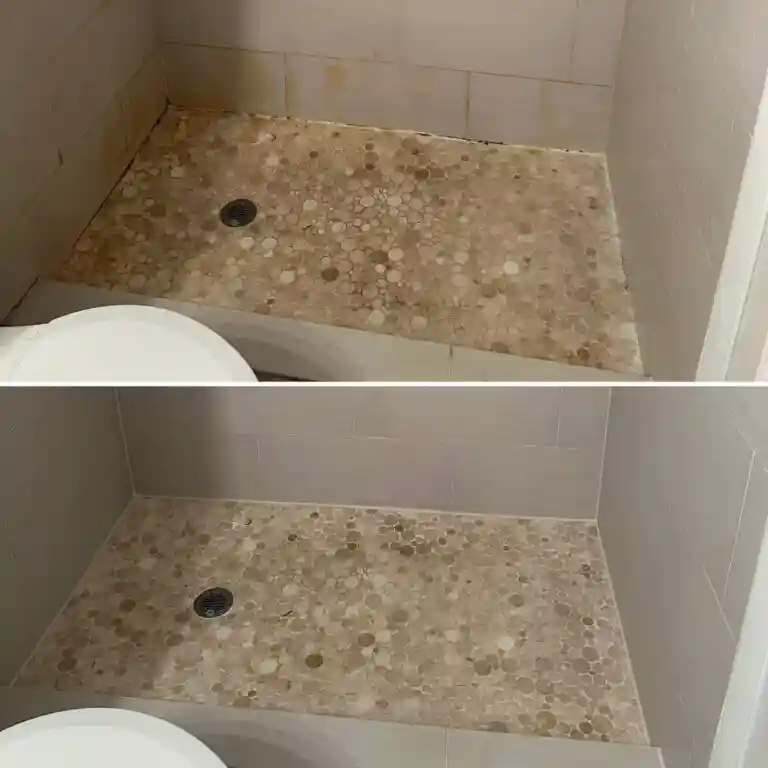
If you have ever had a shower repaired and watched the same cracks come back within a year, you are not dealing with a bad installer. You are dealing with the wrong material. Here is what is actually happening in your shower and why most tile and grout companies in Arizona fix it in a way that is guaranteed to fail again.
Why Shower Corners and Edges Always Crack
Grout is a rigid material. It does not flex. It does not move. When it cures it becomes essentially a brittle compound that holds its shape as long as everything around it holds its shape too.
Your shower does not hold its shape.
Every time you run hot water, the tile, the substrate behind it, and the floor underneath all expand slightly from the heat. Every time the water turns off and the shower cools, everything contracts. This happens every single day, sometimes multiple times a day. Over weeks and months, this constant expansion and contraction creates movement at the transition points in your shower. The corners where the wall meets the floor. The edges where the wall panels meet each other. The seam where the shower floor meets the wall base.
These are called change of plane transitions, and they are where movement concentrates. Rigid grout sitting in those joints simply cannot keep up. It cracks. Not because anything is wrong with your tile or your substrate. Because grout is not designed to handle that kind of movement in that kind of location.
This is not a new tile problem or an old tile problem. It happens in every shower, eventually. The only question is how it gets fixed when it does.
What Most Companies Use to Fix It
When a tile or grout company comes out to repair cracked shower corners, the most common fix is sanded grout caulk.
Sanded grout caulk is a tube product you find at any hardware store. It comes in grout colors, it is easy to apply, and it is significantly easier to work with than the alternative. Most companies reach for it because it gets the job done quickly and the customer can see a color match.
The problem is that sanded grout caulk is not rated for continuous wet exposure. It is a latex-based product. In a shower that runs every day, the constant moisture, heat cycling, and soap and mineral buildup breaks down the latex bond over time. Within six months to a year those joints start cracking again, sometimes peeling away from the surface entirely.
You call the same company back. They caulk it again. Same result twelve months later. The cycle repeats.
What We Use Instead
We use 100% silicone caulk matched to grout colors.
Silicone is a completely different material. It is flexible, meaning it moves with your shower instead of fighting against it. It is fully waterproof rather than just water resistant. It does not break down from heat cycling, continuous moisture exposure, or soap and cleaning product contact. It bonds to tile, stone, and substrate at a level that latex caulk cannot match in a wet environment.
Silicone caulk in matched grout colors gives you the same clean finished look as sanded grout caulk. The color matching across the full range of standard grout colors means the repaired joints blend seamlessly with the rest of your grout. Most homeowners cannot tell from looking at it that the corners are a different material than the grout lines on the flat wall areas, which is exactly the point.
The reason most companies do not use it comes down to one thing: silicone is significantly harder to work with. It has a shorter working window before it starts to set. It does not clean up with water the way latex products do. Application requires more skill and more patience to get a clean finished line. Companies that do high volume repair work avoid it because the extra time and difficulty cuts into their margins.
We use it because a repair that lasts is better than a repair that needs to be redone. For your shower and for our reputation.
How to Tell If Your Shower Needs This Service
Look at the corners and edges of your shower. Not the flat grout lines on the walls, but the transition points where surfaces meet.
If you see cracks running along the corner joint where the wall meets the floor, gaps where the caulk or grout has pulled away from one surface, discoloration or black spotting along the edge lines that does not clean off, a soft or spongy feeling when you press on the corner area, or visible grout crumbling at the change of plane transitions, your shower needs professional corner and edge restoration.
Any of these means water is getting behind the surface. That is the more serious problem underneath the cosmetic one. Water that gets behind tile at corner joints works into the substrate, causes mold growth inside the wall cavity, and over time degrades the structural integrity of the shower installation. A cracked corner that looks like a minor cosmetic issue can become a significant water damage problem if it is left alone.
What the Restoration Process Looks Like
We start by removing all existing failed caulk or grout from the corner and edge joints completely. This step matters more than most companies acknowledge. Applying new material over failing old material is one of the main reasons repairs fail quickly. The old material needs to come out entirely to give the new silicone a clean bonded surface to adhere to.
Once the joints are cleaned out and dried we apply 100% silicone in a color matched to your existing grout. The silicone is tooled to a clean concave profile that matches the look of properly finished grout joints. It cures over 24 to 48 hours and should not be exposed to water during that window.
The result is corner and edge joints that move with your shower, resist moisture completely, and will not crack from normal use the way rigid grout or latex caulk will.
Most Scottsdale and North Phoenix shower restorations are completed in a single visit. We can also combine corner and edge restoration with a full shower cleaning if the tile and grout lines on the flat surfaces need attention at the same time.
Ask About the Material Before You Book Anyone
If you are getting quotes for shower repair from multiple companies, ask one specific question: what material do you use in the corner and change of plane joints?
If the answer is grout, grout caulk, or sanded caulk, you already know what you are getting and roughly how long it will last. If the answer is 100% silicone matched to your grout color, you are talking to someone who knows the difference and is willing to do the harder work.
We are happy to answer any questions about our process before you book.
Text photos of your shower corners and edges to (480) 761-1166. We will assess what you are dealing with and have a quote back to you within 2 hours. Serving Scottsdale, North Phoenix, Paradise Valley, Cave Creek, and surrounding areas. Licensed and insured. ROC 346026.
Grout Nurse has been serving Arizona homeowners since 2013. We specialize in shower cleaning and repair, tile and grout restoration, color sealing, and natural stone polishing. Visit groutnurse.com or call (480) 761-1166.