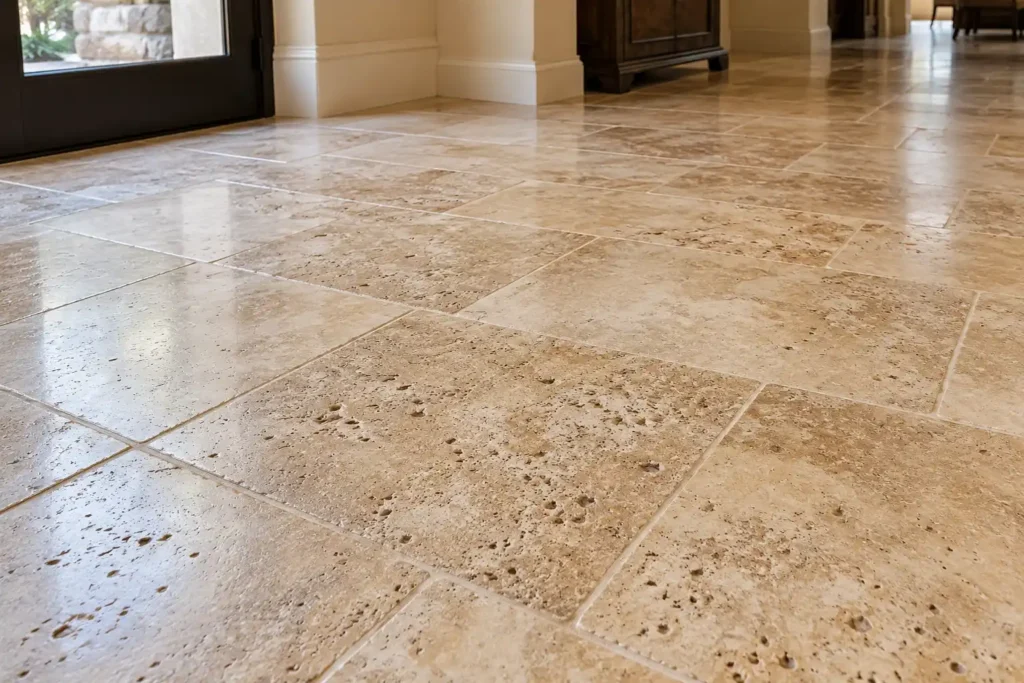
Travertine is beautiful, durable natural stone, but it doesn’t stay perfect forever. Over time, travertine floors, showers and other surfaces can become dull, scratched, etched, stained or develop small holes and pits.
When that happens, homeowners often assume the stone needs to be replaced.
The good news is that many types of travertine damage can be professionally restored. The important question is what kind of damage you have and whether the problem is limited to the surface or involves the stone itself.
Dull or Worn Travertine Can Usually Be Restored
One of the most common problems with older travertine is a dull, uneven or generally tired appearance.
Foot traffic gradually wears the surface, while cleaning products, dirt and mineral buildup can further change its appearance. You may notice that areas along walls still look good while heavily traveled areas have lost their original finish.
This is usually an excellent candidate for restoration. Professional cleaning, honing and polishing can often bring back a consistent finish without replacing the stone.
Scratches Can Often Be Removed or Reduced
Light and moderate scratches can frequently be corrected by honing the surface with progressively finer abrasives.
Unlike applying a coating that temporarily hides scratches, honing works directly on the stone to create a new, even surface.
Very deep scratches may not disappear completely. Removing them would require removing more stone, so the goal sometimes becomes making the damage significantly less noticeable rather than chasing a single deep scratch too far into the tile.
Etching Can Usually Be Repaired
If your travertine has cloudy spots, rings or areas that suddenly look dull, the problem may be etching rather than staining.
Acidic substances and inappropriate cleaning products can chemically react with the stone and alter its surface. Because etching is actual surface damage, ordinary cleaning won’t remove it.
Honing can usually remove or dramatically improve etch marks, after which the stone can be refinished to match the surrounding area.
Small Holes and Pits Can Often Be Filled
Travertine naturally contains voids and cavities. Many travertine tiles are filled during manufacturing, and those fillers can eventually loosen or fall out.
Small holes, pits and missing filler can often be repaired with appropriate filling materials and blended into the surrounding stone.
This is particularly useful on travertine floors, where open holes can collect dirt and make an otherwise attractive floor look worn and neglected.
Stains Depend on What Caused Them
Some travertine stains can be removed or substantially improved, but staining is one area where results can vary.
The outcome depends on what caused the stain, how deeply it penetrated the stone and how long it has been there. Oil, rust, organic stains and mineral deposits can behave very differently.
That’s also why simply scrubbing harder isn’t necessarily the answer. Using the wrong chemical on natural stone can turn one problem into two.
What About Scottsdale’s Hard Water?
Here in Scottsdale and throughout the Phoenix area, hard water creates another challenge for travertine, especially in showers and bathrooms.
Mineral deposits can build up on the stone and around grout lines, leaving white or cloudy areas that ordinary bathroom cleaners may not remove safely.
Professional cleaning can often remove substantial hard-water buildup, but prolonged exposure may also leave etching or other surface damage that requires honing or additional restoration.
What Travertine Damage Can’t Always Be Fixed?
Natural stone restoration can accomplish a lot, but it has limits.
- Severely cracked or broken tiles may need to be replaced.
- Movement in the floor or substrate must be corrected or cracks may return.
- Major structural damage cannot be solved by polishing or sealing the surface.
- Extremely deep stains may improve without disappearing completely.
- Deep chips or missing sections may require repair or replacement rather than normal restoration.
- Color variations within the stone are natural and cannot simply be polished away.
If replacement tiles are required, matching older travertine can also be challenging because natural stone varies from one quarry and batch to another.
Can Sealing Repair Damaged Travertine?
No. This is an important distinction.
Sealing helps protect travertine, but it doesn’t repair damage that is already there. A sealer won’t remove scratches, fix etching, restore a worn finish or magically eliminate stains.
If the stone needs restoration, that work should generally be completed first. Sealing can then be used when appropriate to help protect the restored surface.
Restore or Replace? Let The Grout Nurse Take a Look
If your travertine is looking rough, don’t assume replacement is your only option. Many floors, showers and other travertine surfaces that look badly worn can be restored for years of additional use.
The Grout Nurse can evaluate the condition of your travertine and determine whether it needs professional cleaning, honing, polishing, filling, sealing or more extensive repair.
Before you tear it out, find out if we can bring it back. Contact The Grout Nurse and let us take a look at your damaged travertine.